
When You're the Outsider, Trust Has to Be Built by Hand
Legacy sectors run on memory. The relationships are already established. Suppliers know buyers personally. Buyers know which vendors deliver on time, which ones pick up the phone when something goes wrong, and which ones can be trusted when the stakes are high. A new company is therefore competing against something much harder to replace than a product. It is competing against familiarity.
That is why a new player cannot simply walk into a legacy sector and say, “We offer better quality,” “We have better pricing,” or “We are the next generation of the industry.” You earn it the way you earn a nickname, against your will, over years you don't get to skip.
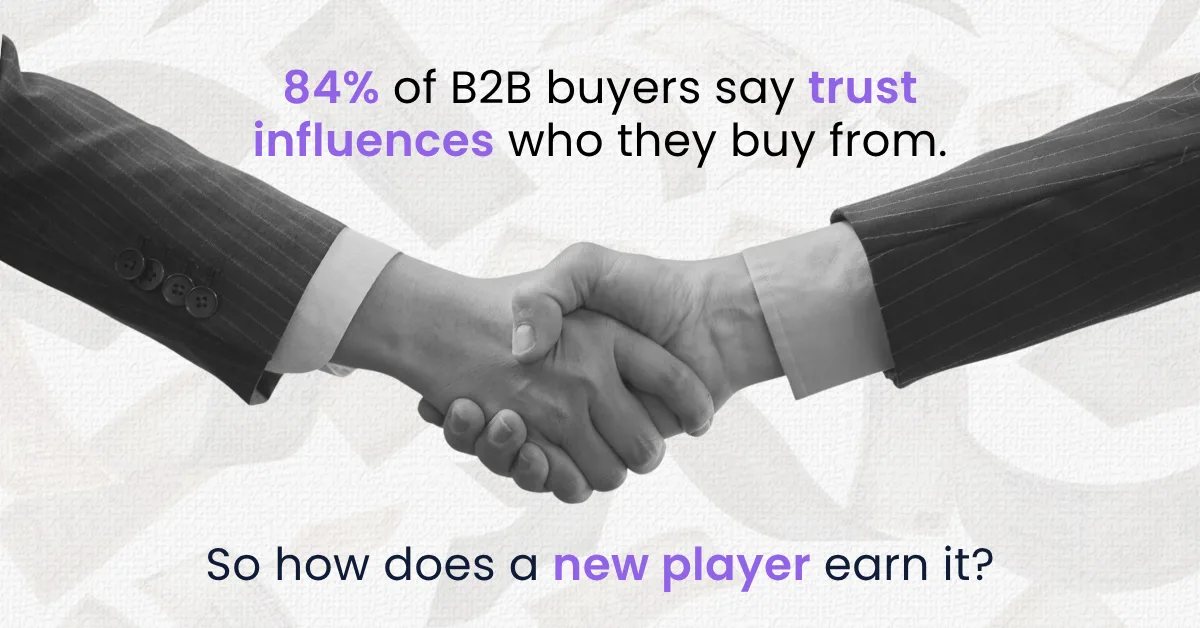
Forrester's research on B2B trust is blunt about this: incumbents have a structural head start, because familiarity itself breeds trust. Their global survey found buyers were twice as likely to recommend companies they trusted and nearly twice as likely to pay a premium to keep working with them, and incumbent vendors enjoy considerable advantages simply because familiarity breeds trust. That's not a comforting stat if you're new. But the same research offers a way in: non-incumbents can still build trust by investing in thought leadership content and building influence with sources buyers already trust, including company leaders and industry analysts.
Trust Is Borrowed
Trust in legacy sectors is built buyer-to-buyer, then borrowed. Forrester's 2023 B2B Brand and Communications Survey found that over 90% of respondents believe buyers trust their professional peers, and 85% trust the customers of vendors in their industry, while salespeople from vendors rank as the least trusted group tracked, at just 29%. Your job is to engineer enough good outcomes that someone else does the selling for you.
The Levers That Move
So what actually moves the needle, mechanically? Forrester breaks trust into seven levers. Consistency, competence, dependability, accountability, empathy, integrity, transparency and notes that domain expertise, industry expertise, and technology expertise rank among the top purchase drivers. Of the seven, three carry disproportionate weight early on: consistency, competence, and dependability. That tracks with anecdotal accounts too. One operator building a subcontracting business described being told point-blank that “in B2B, people don't buy from companies, they buy from humans they already trust”.
For New Entrants
Show your work before you ask for the sale. Publish the technical detail competitors keep proprietary, grading standards, sourcing chains, pricing logic, safety data.
Borrow credibility deliberately. Get referenced by the analysts, trade publications, and veteran operators the sector already trusts. A single citation from a respected old-timer does more than a year of your own content.
Make small, visible commitments and keep every one of them. Consistency is a trust lever precisely because legacy buyers have been burned by inconsistency before. Consistency reassures buyers that promises will be kept repeatedly, and it requires continuous improvement rather than a one-time proof point.
Treat every relationship as compounding. "Every relationship compounds. But only if you keep depositing" is the operating principle in slow-moving industries where the buyer pool is small and everyone eventually talks to everyone.
Don't try to out-innovate the incumbents on trust itself. You won't win on tenure. You win on being unusually reliable, unusually transparent, and unusually present, showing up when it's inconvenient, answering when it's not required, delivering slightly past what was promised.
Acting Like an Insider Before You Are One
None of this shortcuts the process. Trust in legacy sectors is still slow, still earned transaction by transaction, still resistant to marketing shortcuts. But the research is clear that new entrants are shut out by strategy, specifically the strategy of trying to claim trust instead of demonstrating the three things buyers actually weigh: consistent behavior, visible competence, and dependability under pressure. Layer in borrowed credibility from voices buyers already trust, and a new player's disadvantage stops being structural. It becomes a matter of time and time, unlike trust, is something every new entrant eventually gets anyway.