
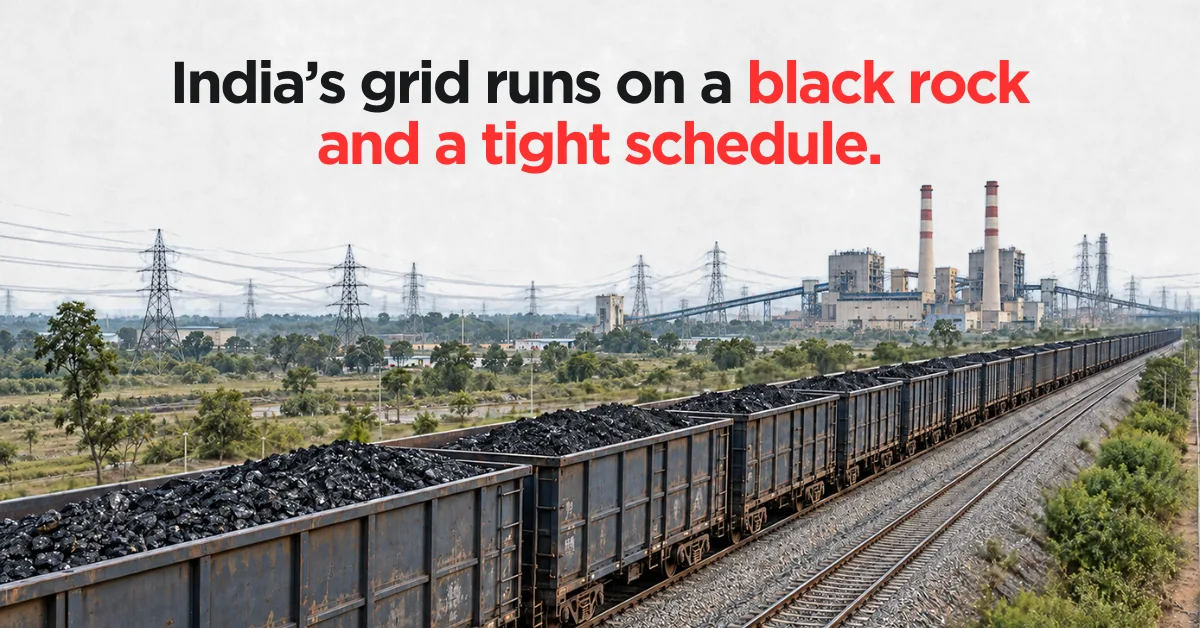
Somewhere in India right now, a train full of coal is running late. It's one wagon in a long chain, and that chain is holding up a grid with record appetites. This September, with a weak monsoon and a country that won't stop switching things on, everyone is.
The arithmetic of a hot year
Power consumption growth has stayed above 10% since May, pushed by cooling, irrigation and general economic busyness. Meanwhile the stockpile that was meant to absorb all this has been vanishing. Coal at thermal plants fell to about 28.6 million tonnes by 1 September, from 59.3 million at the start of the financial year. That's roughly half the cushion gone in five months.
Supply isn't the villain (and that's the point)
The tally of plants on the edge keeps ticking up. Plants with critically low stock, meaning under 25% of required inventory or less than three days of fuel, rose to 58 by 5 September from 46 at the end of August. The state's answer has been to move faster. Daily coal loading climbed from 370 rakes on 3 September to 444 on 6 September. And the government is raising output from captive mines and loading more at select Coal India subsidiaries.
Coal India supplied 322.9 million tonnes in the first five months of FY27, up 6.7% on last year. The company also says it's sitting on 76 million tonnes at its pitheads. So the coal exists. It's just in the wrong place at the wrong hour, waiting on wagons, which is why ministries of power, coal and railways are now in the same room. The crisis is that India keeps rediscovering, every few years, that digging a thing up and delivering it are two different professions.
We've seen this film
We've done this exact play before. In 2021, over half of the 135 coal-fired plants had less than a week's stock, and six had run dry. Then, as now, the government shouted for more rakes. Fairness matters here, though. Stockpiling isn't free. Coal sitting at a plant costs money, can degrade, and ties up working capital, so there's a real tension between buffer and efficiency. Reasonable people can disagree on how fat the cushion should be. What's harder to defend is a cushion that's thick in April and gone by September every time the monsoon misbehaves.
The brochure and the basement
The pamphlet version of India's energy story is solar-drenched and gleaming. And it's true that the country has around 228 GW of non-fossil capacity. But in May, when peak demand hit a record 270.8 GW, coal still supplied more than 70% of generation. A grid is a promise made to a billion-odd people at once, and right now the promise is mostly kept by something black, heavy, and Victorian in spirit.
The Last Mile Is Made of Coal
This particular squeeze will probably ease. Rakes are moving, pithead stock is healthy, and the machinery of the state is, for once, pointed in the same direction.
But the more interesting movement is whether the next planning cycle treats rail capacity and pre-season stocking as permanent infrastructure rather than emergency spending.